

Introduction: Your Blueprint for Supermarket Success
Embarking on a supermarket venture without a solid supermarket business plan is like navigating a ship without a compass. You might eventually reach your destination, but the journey will be fraught with avoidable risks and costly detours. As a retail business consultant with over a decade of experience, I’ve witnessed how a well-structured plan can transform ambitious ideas into thriving enterprises.
The retail landscape in 2025 demands more than just capital—it requires strategic foresight. A comprehensive supermarket business plan serves as your strategic roadmap, helping you secure funding, anticipate challenges, and capitalize on emerging opportunities. In this guide, I’ll share insider knowledge to help you craft a document that not only impresses investors but becomes your daily operational guide.
Why Your Supermarket Needs a Strategic Roadmap

The Foundation of Success
Think of your supermarket business plan as the foundation of your enterprise. It’s the document that transforms your vision into actionable strategies. Recent industry analysis shows that supermarkets with detailed plans have a 35% higher survival rate in their first three years of operation.
Beyond Funding: Operational Excellence
While securing financing is a crucial function of your plan, its value extends far beyond the boardroom. Your strategic document should serve as a living guide that helps you:
- Make informed daily operational decisions
- Adapt to market changes quickly
- Measure performance against clear benchmarks
- Align your team around common objectives
Crafting Your Executive Summary: The Gateway to Investment
Capturing Attention in One Page
Your executive summary is the most critical section of your proposal. It’s the gateway that determines whether busy investors will read further. Craft this section to perfection, ensuring it encapsulates your entire vision with compelling brevity.
Essential components include:
- Your unique value proposition in the competitive landscape
- Financial highlights and growth projections
- Management team credentials and experience
- Market opportunity and your strategy to capture it
Market Analysis: Understanding Your Battlefield
Industry Outlook for 2025
The global grocery retail market is projected to reach $14.5 trillion by 2025, with emerging markets showing particularly strong growth. Understanding these macro-trends is crucial for positioning your supermarket for success.
Identifying Your Target Customer
Go beyond basic demographics in your analysis. Develop detailed customer personas that include:
- Shopping habits and preferences
- Price sensitivity levels
- Brand loyalty tendencies
- Technology adoption patterns
Strategic Business Modeling
Choosing Your Operational Format
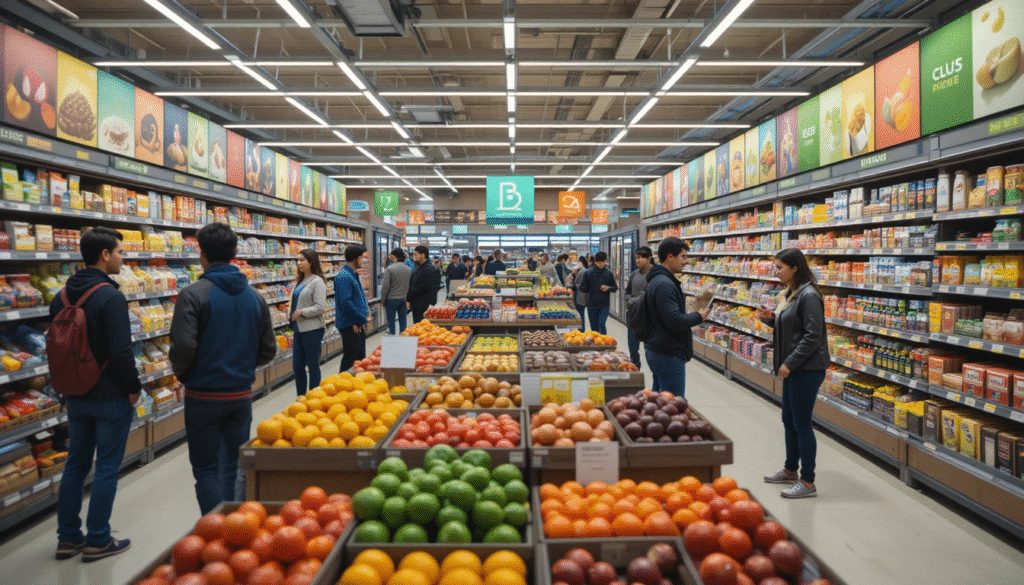
Your strategic document must clearly define your operational model. Consider these popular formats:
- Community-Focused Markets (2,000-5,000 sq. ft.)
- Mid-Size Family Supermarkets (5,000-10,000 sq. ft.)
- Destination Superstores (10,000+ sq. ft.)
Legal Structure Considerations
Select a legal framework that supports your growth ambitions while managing risk:
- Sole proprietorship for simple, small-scale operations
- LLC or private limited company for larger ventures
- Partnership structures for collaborative investments
Financial Planning: The Heart of Your Proposal
Startup Investment Requirements
Your financial section must provide transparent, realistic numbers:
Initial Capital Requirements:
- Location security and advance: ₹5-10 lakhs
- Store fit-out and renovation: ₹15-25 lakhs
- Shelving and equipment: ₹8-12 lakhs
- Technology systems: ₹10-15 lakhs
- Opening inventory: ₹20-30 lakhs
- Licensing and compliance: ₹2-3 lakhs
Total Initial Investment: ₹60-95 lakhs
Operational Economics
- Monthly rental expenses: ₹1-2 lakhs
- Utility costs: ₹50,000-₹1 lakh
- Payroll and staff expenses: ₹3-5 lakhs
- Inventory replenishment: ₹50 lakhs-₹1 crore
- Marketing and promotions: ₹50,000-₹1 lakh
Revenue and Profit Projections
- Expected monthly revenue: ₹1-2 crores
- Target gross margin: 18-22%
- Operating expense ratio: 12-15%
- Projected net margin: 6-8%
- Monthly net profit potential: ₹6-16 lakhs
Implementation Strategy: From Plan to Action
Phase-Based Launch Timeline
Create a realistic implementation schedule:
- Months 1-2: Location finalization and legal compliance
- Months 3-4: Physical setup and vendor development
- Month 5: Staff recruitment and training
- Month 6: Soft launch and operational testing
Performance Monitoring Framework
Establish clear KPIs to track your progress:
- Sales per square foot
- Inventory turnover rates
- Customer retention metrics
- Employee productivity measures
Risk Management and Contingency Planning
Identifying Potential Challenges
Acknowledge and address potential obstacles:
- Increasing competitive pressure
- Supply chain disruptions
- Changing consumer preferences
- Regulatory changes
Proactive Mitigation Strategies
Develop contingency plans for:
- Alternative supplier relationships
- Cash reserve requirements
- Flexible staffing models
- Adaptive marketing approaches
Conclusion: Turning Vision into Reality
Your strategic plan is more than a document—it’s the embodiment of your supermarket dream. Remember that the most successful retailers treat their plans as living documents, regularly updated to reflect market changes and new opportunities.
Begin your planning journey today with the insights from this guide. With careful preparation, strategic thinking, and relentless execution, your supermarket can become a profitable and cherished community destination in 2025’s competitive retail landscape.


Pingback: Aloe Vera Farming Profit Per Acre: Complete 2025 Business Guide - Knock4u Business Idea